

I finally watched SINNERS
I watched Sinners last night… It was really good. And that is saying something special because I haven’t seen anything on a large or a small screen in years that wasn’t boring...

I watched Sinners last night…
It was really good. And that is saying something special because I haven’t seen anything on a large or a small screen in a long time that I did not find boring and rehashed. I’m a jaded viewer of the first order, so the thing that makes THIS film stand out to me, is its original story line. (And I offer that with qualifications as well… because I know that the intense focus on that one convenient location is a movie maker’s attempt to save money. And the juke joint felt really reminiscent to me of the Juke Joint in The Color Purple. Abandoned warehouses as central filming locations are feeling a little cliche right now—I’ve seen three distinct movies/shows just this week that feature an abandoned warehouse—but I can let it pass in this case, because the location is the right one. Everything Everywhere All at Once taught me the importance of location and how to keep filmmaking costs down.)
Michael B. Jordan was delicious. There would be no movie here without him. He portrayed twins Smoke and Stack both with undeniable charisma. I couldn’t take my eyes off of him. I read somewhere that Jordan worked with real twins to get the subtle differences right. So, kudos to the casting department, the director, and most of all to Mr. Jordan. The other actor I loved seeing most was legendary blues guitar player Buddy Guy. I’m glad they found a way to honor that old blues man. I wonder if he’s the last of those Delta bluesmen…
S P O I L E R A L E R T
I don’t want to give anything away, so if you haven’t seen the film, you might want to stop reading here. Most folks will be aware by now that Sinners is considered a horror film because the storyline deals with vampires. But I find that label misleading. I don’t care for “horror” when it’s just blood and guts and jump scares, but I like a good supernatural thriller, and that is the category where I’d place this film. Yes, there are vampires, but the story is not just about vampires. It is about oppression and oppressed peoples.
I read comments about the film before I watched it. They talk about colonialism, and the oppressed Irish vampires becoming the oppressor.
And that led me to comparisons with a novel I’ve never forgotten, A Mercy, by Toni Morrison, which deals with society on this continent before there was government. In that novel four women from different backgrounds try to survive in a man’s world when the master of the house dies. The huge sad message being that women had to have protection—if not from a husband or father, then from an organization like the church. There had to be a male figure to sign off on anything and everything in a woman’s life. Women couldn’t survive for long on their own, because they weren’t allowed to own property, while white men could buy and sell human beings.
Then there was the clear reference to the miscegenation laws that existed throughout the south into the 1970s—the “one-drop rule” that said if there was any Black blood in your lineage at all, you were considered Black. Blacks and whites couldn’t legally marry. In Sinners, the character Mary represents a light skinned woman who can “pass” as white. But she doesn’t want to. Her conflict is clear, and her character is beautifully flawed because of it.
Most of all, music drove the film—Delta Blues interlaced with Irish folk music. The two live in my head in separate but adjacent boxes. The instrumentation could be similar, but the instruments were played in very different ways. Irish traditional dance with it’s rigid, straight up and down leaps and flourishes represents White music, while the Delta Blues represents the Black. But of course the one influenced the other, and there are threads of both in Sammie’s magic that connects his music with the ancestors, bringing the threads of musical ancestral history together, and allowing the all the ancestors, past and future, to dance. There’s a big dance scene I’d heard about in which the ancestors appear and dance in the juke joint when Sammy plays. I wanted more of that. Meanwhile the vampires play and dance a fierce “Rocky Road to Dublin” to fit the frenzied mood. The only thing I can say about the music is that I wish there was more.
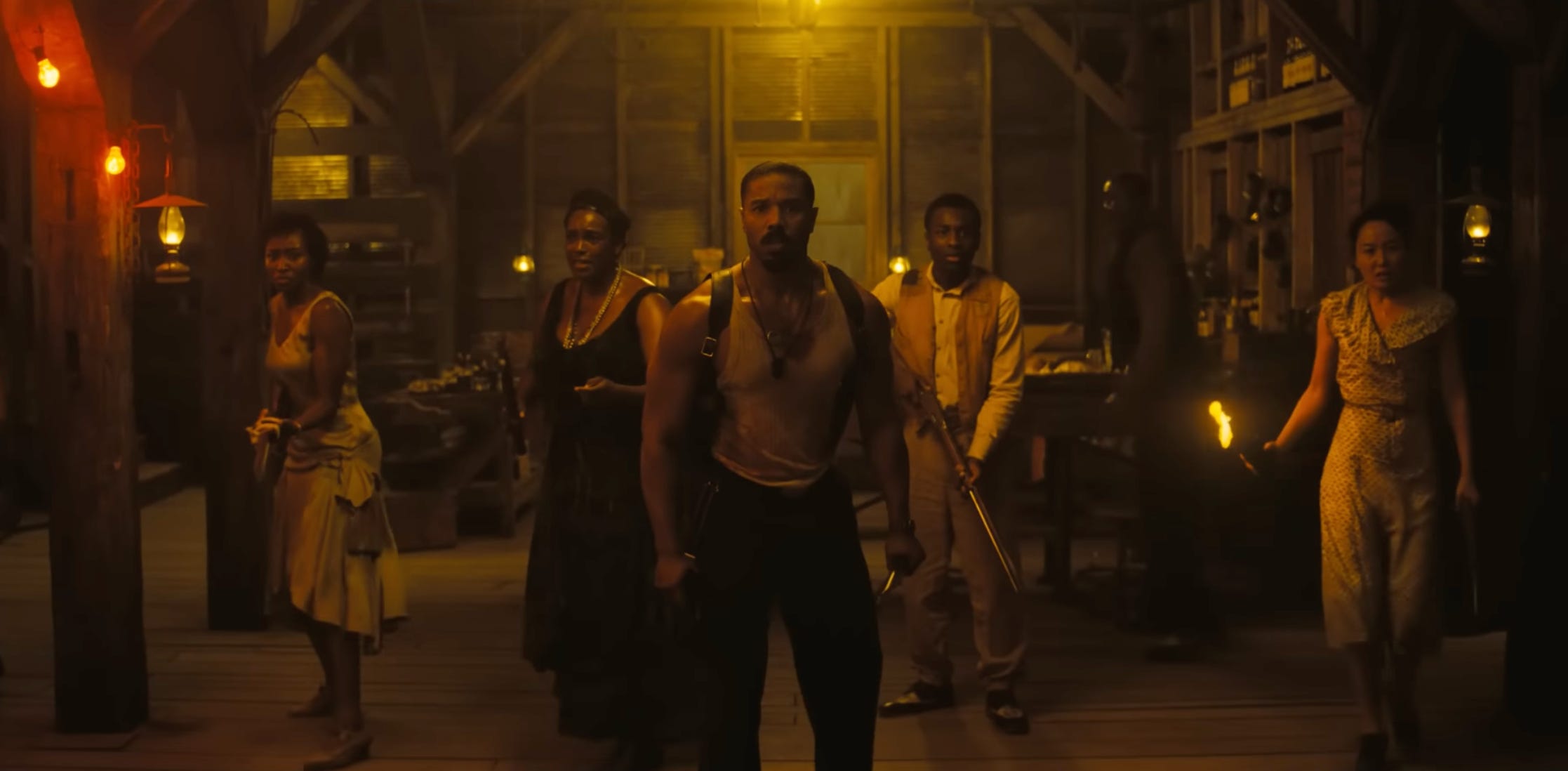
It was a big, atmospheric, beautifully shot film. Sure, there is going to be talk about race. The film is shot in the Jim Crow south of the 1930s. It’s sharing an important portrayal of that odd life that should never be forgotten, and should never be repeated. In an odd way, I felt good at the end of it—after Smoke settled the score with the Klan.
I liked the music, but wasn't as taken by the whole as I wanted to be. It was as if something mythic was trying to grow there but devolved into a From Dusk Til Dawn. Guess I'm missing something.